
Author: Eva Penín
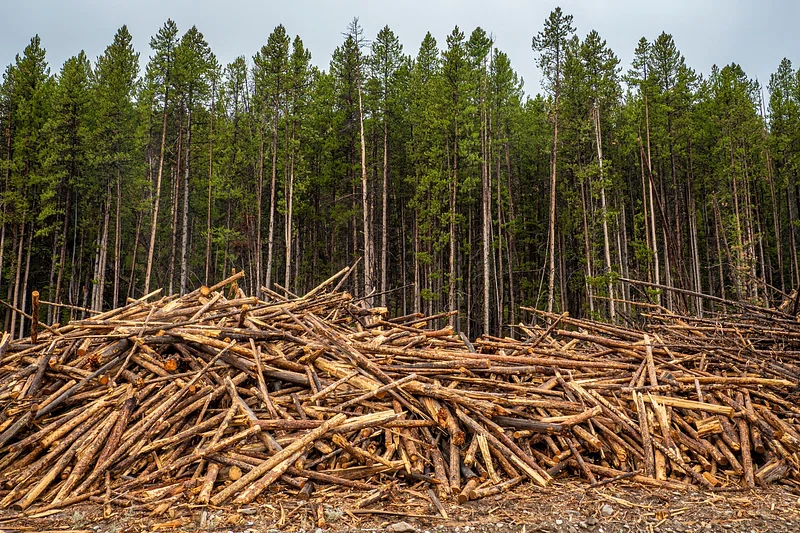
Climate change has become one of the most pressing global challenges of the 21st century, driven primarily by increasing concentrations of greenhouse gases (GHGs). Among its anthropogenic causes, deforestation and forest degradation stand out, contributing approximately 11% of global carbon dioxide (CO₂) emissions [1]. Forests act as carbon sinks, absorbing large quantities of CO₂ and mitigating climate change. Globally, they cover almost a third of the Earth’s land surface (4.14 billion hectares), but this area is decreasing, especially in the tropics. Since 1990, 489 million hectares of forest have been lost, although the rate of loss has slowed in the last decade [2].
Deforestation has intensified in regions such as Africa and South America, while in other economies, such as Europe or China, forest cover has remained stable or even increased [2, 3]. This has highlighted the concepts of “displaced” and “imported” deforestation, linked to the externalisation of environmental impacts through consumption. It is estimated that 26% of deforestation in the tropics is linked to international demand, and nearly one-third of emissions from forest loss come from international trade [3].
Over the past three decades, global environmental agreements, trade regulations, and actions by public and private actors have been implemented to curb deforestation [4,5]. However, their effectiveness has been limited, and the growing demand for forest products (timber, pulp, paper) and agricultural commodities (livestock, palm oil, soy, cocoa) continues to account for 90 to 99% of forest loss, especially in the tropics and subtropics [3,6].
The EU is the second-largest importer of forest-risk commodities (FRCs) due to its consumption patterns and policy incentives [7, 8]. This gives it significant responsibility for the global deforestation associated with the trade in FRCs. Until recently, there was no European legislation that directly addressed this issue or the associated emissions outside EU territory. As a result, in 2023, Regulation (EU) 2023/1115 on deforestation-free products (EUDR) was established to reduce GHG emissions and biodiversity loss through the consumption of deforestation-free products. It establishes rules to ensure that products consumed in the EU do not contribute to forest loss, reduce associated carbon emissions by at least 32 million tonnes annually, and address deforestation linked to agricultural expansion [9]. The EUDR expands the scope of the previous EU Timber Regulation (EUTR), including key agricultural products (livestock, cocoa, coffee, palm oil, rubber, soy), and introduces zero-deforestation and zero-forest-degradation standards, reinforcing due diligence, monitoring, and enforcement. It is also framed within strategic EU initiatives such as the European Green Deal, the 2030 Biodiversity Strategy, and the Farm to Fork Strategy, consolidating European leadership in the fight against deforestation [10]. Despite its creation in 2023, its approval has been postponed to facilitate the transition, with a mandatory review by the Commission before April 2026 for potential further simplification, following a political agreement between the Parliament and the European Council.
In this context, the EMBEDED project actively contributes to reducing deforestation and complying with current and future environmental legislation through an integrated approach based on the circular bioeconomy and sustainable land-use management. Through biochar production, the project partners aim to reduce emissions associated with land-use change by stably sequestering carbon and alleviating pressure on forest ecosystems. Likewise, the valorisation of agricultural residues and industrial by-products, such as those from the cork sector, will enable the production of alternative materials to replace wood in structural, sanitary, and urban furniture applications, thereby reducing demand for products linked to deforestation. Finally, the project will generate data, technical knowledge, and best practices that strengthen due diligence processes and sustainability assessments, facilitating alignment with the objectives of a deforestation-free economy.
[1] Intergovernmental Panel on Climate Change, Climate Change and Land: An IPCC Special Report on Climate Change, Desertification, Land Degradation, Sustainable Land Management, Food Security, and Greenhouse Gas Fluxes in Terrestrial Ecosystems (IPCC 2019) https://www.ipcc.ch/srccl/ accessed 12 January 2026.
[2] FAO. 2025. Global Forest Resources Assessment 2025. Rome. https://doi.org/10.4060/cd6709en
[3] Pendrill, F., Persson, U. M., Godar, J., & Kastner, T. (2019). Deforestation displaced: trade in forest-risk commodities and the prospects for a global forest transition. Environmental Research Letters, 14(5), 055003.
[4] Begemann, A., Giessen, L., Roitsch, D., Roux, J. L., Lovrić, M., Azevedo-Ramos, C., … & Winkel, G. (2021). Quo vadis global forest governance? A transdisciplinary delphi study. Environmental Science & Policy, 123, 131-141.
[5] European Commission. (2020). An EU legal framework to halt and reverse EU-driven global deforestation. Publications Office of the European Union. https://op.europa.eu/en/publication-detail/-/publication/77fa2d6b-3b62-11eb-b27b-01aa75ed71a1/language-en
[6] Pendrill, F., Gardner, T. A., Meyfroidt, P., Persson, U. M., Adams, J., Azevedo, T., … & West, C. (2022). Disentangling the numbers behind agriculture-driven tropical deforestation. Science, 377(6611), eabm9267.
[7] European Commission, Joint Research Centre. (2021). Stepping up: The continuing impact of EU consumption on nature worldwide. Knowledge for Policy. https://knowledge4policy.ec.europa.eu/publication/stepping-continuing-impact-eu-consumption-nature-worldwide_en
[8] Vasconcelos, A. A., Lima, M. G. B., Gardner, T. A., & McDermott, C. L. (2024). Prospects and challenges for policy convergence between the EU and China to address imported deforestation. Forest Policy and Economics, 162, 103183.
[9] European Commission. (2023). Regulation on deforestation-free products. European Commission – Environment. https://environment.ec.europa.eu/topics/forests/deforestation/regulation-deforestation-free-products_en
[10] Berning, L., & Sotirov, M. (2024). The coalitional politics of the European Union Regulation on deforestation-free products. Forest Policy and Economics, 158, 103102.